
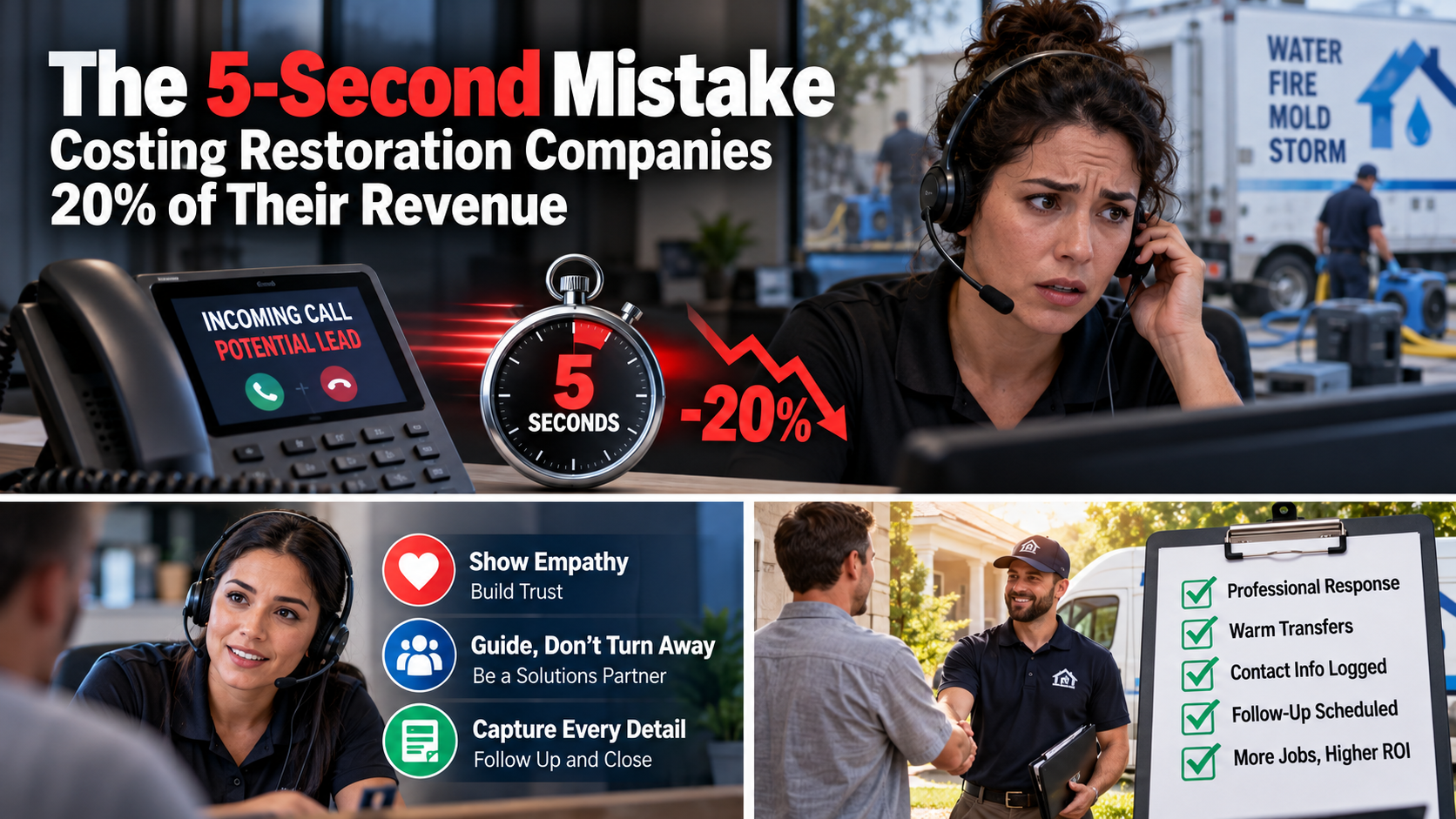
Many home services business owners assume they are taking full advantage of every call that comes into their office, and that they just need more calls. They assume calls that don’t turn into a job are from an existing customer, a vendor, or a wrong number.
Think for a moment about all the resources you are expending in marketing: Google Pay-Per-Click Ads, LSAs, SEO, social media, networking, referral fees, and good old-fashioned, boots-on-the-ground marketing. Your trucks are wrapped, your signs are visible, and your messaging promises you’ll be there when disaster strikes:
“Call Now.”
“Here to Help.”
“Ready 24/7 Because Emergencies Don’t Wait.”
For most of you, virtually all leads come in by phone, so all of that has one primary objective: to make the phone ring with qualified leads.
What’s happening in your office when that call finally comes in?
What if I told you that, based on my direct experience working with home services businesses and reviewing thousands of incoming calls, many businesses lose 20% or more of potential jobs because of poor call handling and inadequate follow-up?
It’s the business equivalent of fumbling the ball on the one-yard line.
And the frustrating part? Many of these lost opportunities are preventable.
Start Listening to Your Calls
If you don’t periodically listen to recordings of incoming calls, you are missing a key opportunity to improve your operations. We review calls generated through online advertising and help clients connect marketing leads to actual jobs and revenue.
Most of your callers are traumatized and afraid due to the disruption and concerns about potential hazards from broken pipes, water loss, fire, mold issues, or even the loss of a loved one. They are seeking help, and your company has promised to provide it. Yet some calls are met with indifference, abrupt answers, confusing instructions, or a lack of urgency. Other callers are given a phone number for someone else and effectively sent on their way, with no contact information collected and no follow-up planned.
You may be surprised, or even shocked, by what you hear when you begin reviewing your own calls.
The good news is that these recordings can identify specific issues that can be addressed through better training, clearer procedures, and increased accountability.
Here are three areas worth examining.
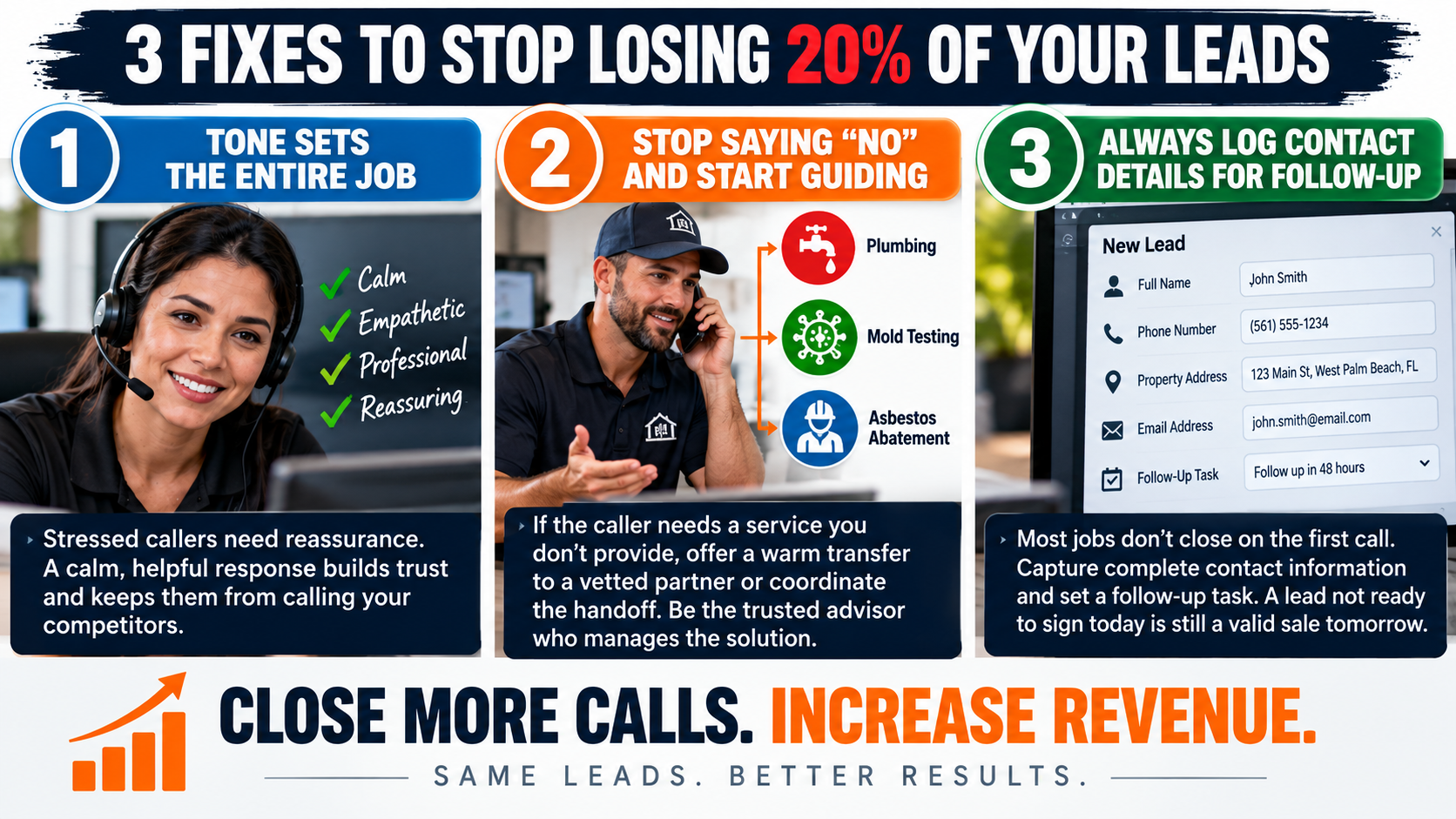
1. All That Really Matters Is Your Attitude
Most of your marketing reaches people in a mass-market environment. Your website, advertising, social media posts, truck graphics, and signs reach hundreds or thousands of people at once.
When the phone rings, you have now have the opportunity to connect with an individual in a personal and meaningful way.
Make this interaction count.
Callers who have experienced property damage are often stressed and overwhelmed by the disruption to their lives, their home’s condition, the cost, and what comes next. They don’t expect your receptionist to solve every problem on the spot. But they do need to feel that they’ve reached someone who cares and can guide them toward a solution.
A warm greeting, calm tone, patience, and a desire to help are essential.
And don’t underestimate the impact of a negative interaction. There are one-star Google reviews left by people who called a company by mistake and received a curt or rude response. Even if the caller isn’t a prospective customer, YOU WILL make a first impression of your business.
Even if the caller doesn’t need your services today, you want them to remember your company as helpful and professional when a need arises in the future.
2. Reassure the Caller: “You’ve Reached the Right Place”
When someone calls for help, your team should communicate one essential message: We’re glad you called, and we’ll help you determine the next step.
This does not mean promising services you cannot provide or telling callers what they want to hear if it is not accurate. It means approaching every conversation with a helpful, solution-oriented attitude.
Always start the conversation on a positive note: instead of focusing on what you cannot do, explain what you can.
Do not handle a caller with a mold-testing question by simply giving them a number and ending the conversation. If your company doesn’t provide that service, offer to connect them with a qualified provider in your network. When appropriate, make a warm transfer rather than leaving the caller to start over with another business.
The same principle applies to wrong numbers. A polite response and helpful direction can turn an accidental call into a positive impression of your company.
Your employees do not need to have all the answers, but they must take ownership of helping callers find solutions.
3. Always Capture Contact Information — and Follow Up
This is one of the most important, yet frequently overlooked, parts of handling incoming leads.
At a minimum, your team should consistently collect the caller’s name, phone number, service address, and email address. This information should be recorded in a system with clear responsibility for the next step.
Why is this especially important in restoration?
A water damage customer may need a plumber, an insurance adjuster, mold testing, asbestos testing, or foundation work before restoration can proceed. The customer may need time to make decisions or coordinate with other parties. Each of those interactions is an opportunity for them to be referred elsewhere or find an alternative solution, and the lead can disappear.
I’ve heard calls in which a receptionist gives a caller a hygienist’s phone number without even collecting the caller’s name or contact information. You say you rely on that relationship with the hygienist to ensure the job comes back to you, but what if the prospect never calls them? The conversation ends, and you have no way to follow up.
Meanwhile, that same prospect may be talking to an insurance adjuster, a friend, or another contractor who recommends a competing restoration company.
You have already invested in getting that person to call. Don’t abandon the opportunity just because the job cannot begin today.
A better approach is to capture the information, document what the caller needs, and set up a clear follow-up process—add them to your WIP board. Your team can follow up at a suitable time, answer questions, and determine whether the customer is ready for the next step.
A lead that isn’t ready today isn’t necessarily lost, but a lead that is never recorded is as good as lost.
Make Call Reviews Part of Your Routine
Start by regularly reviewing a sample of incoming calls, including those that didn’t turn into jobs.
Look for patterns:
- Are calls answered promptly and professionally?
- Does the person answering sound genuinely interested in helping?
- Are callers reassured and given next steps — do they feel like they have a solution?
- Is contact information consistently collected?
- Does the caller feel like they have been given a solution?
- Are leads documented and assigned for follow-up?
- Do you know which calls resulted in jobs, and which opportunities were lost?
Use what you learn to coach your team, improve procedures, and track results over time.
Call Attribution and Revenue Tracking
Advertising reports can tell you how many calls a campaign generated, but connecting those calls to actual jobs and revenue tells you much more about what your marketing dollars accomplished. The only way to really know whether your advertising dollars are well spent is to connect call records to their source, estimates, completed jobs, and revenue. That helps you distinguish between calls that merely occurred and leads that produced real business. Clicks and click-through rates that most agencies provide are practically meaningless in determining the true effectiveness of your marketing expenditure. We provide a system to determine ROI on paid advertising for all of our clients.
Here’s a simple challenge: Spend the next week listening to your incoming calls. Don’t just listen for whether your team answered the phone. Listen to how callers were treated, what information was collected, and what happened next.
You may discover that one of your biggest opportunities to grow revenue isn’t finding more leads. It’s doing a better job with the leads you’re already getting.
About Michael Baxter and Harben Marketing
Michael Baxter is Director of Customer Success at Harben Marketing, a full-service digital marketing agency specializing in helping home services businesses grow. With 16 years of experience in the property restoration industry and extensive digital marketing experience, Michael brings a unique understanding of the challenges home services companies face and what it takes to attract more customers online. Harben Marketing combines industry knowledge with expertise in SEO, Google Business Profile optimization, Google Local Services Ads, paid advertising, website development, and more to help businesses increase online visibility, generate qualified leads, and grow their business.